A GPS-tagged condor chick and a whale that swam over 13,000 km: the animal journeys amazing scientists
For World Animal Day, scientists shared remarkable tracking data: a young Andean condor followed by satellite in Peru and a right whale that traveled with her calf a distance equal to crossing the Atlantic twice.
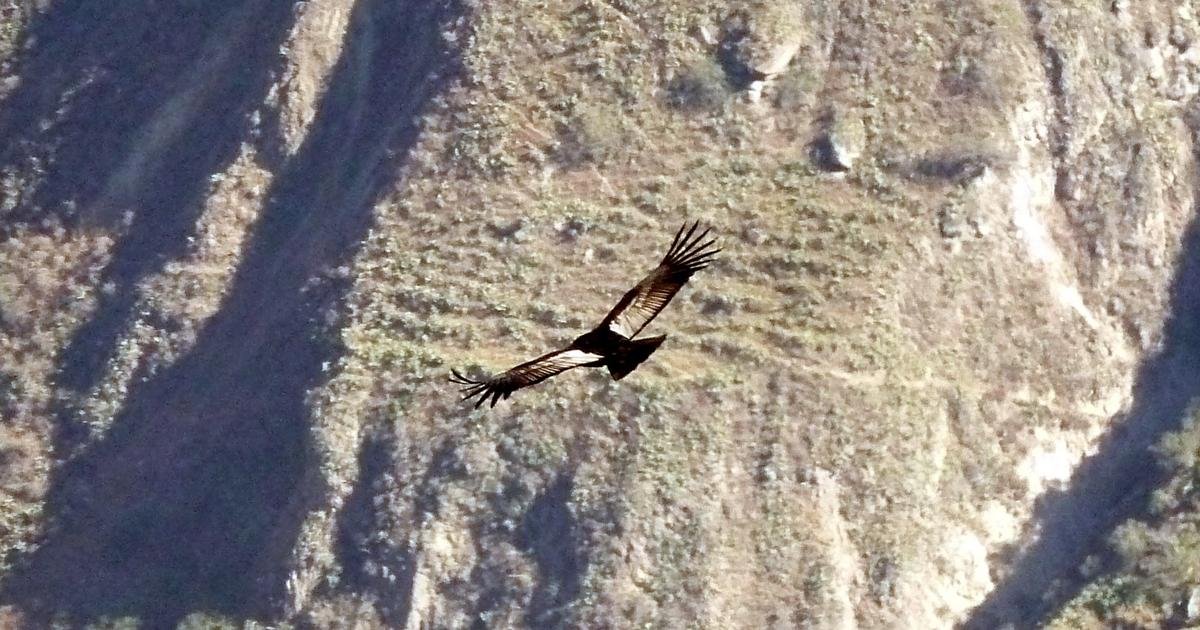
Photo: pululante / Wikimedia Commons · CC BY 2.0
On October 4, World Animal Day, social media filled up with pet photos. But among all the dogs and cats, two stories left thousands of people amazed: an Andean condor chick fitted with a tiny GPS transmitter in Peru, and a right whale that traveled more than 13,000 kilometers with her calf. Both show how much technology is changing what we know about wildlife.
The condor: giant of the Andes
The Andean condor (Vultur gryphus) is one of the largest flying birds in the world: its wingspan exceeds three meters, and an adult male can weigh 11 to 15 kilos. It is a national symbol in several Andean countries and appears on the coats of arms of Bolivia, Chile, Colombia and Ecuador.
Even so, the IUCN lists it as vulnerable. Its main threats are poisoning (often from toxic baits meant for other animals), lead from ammunition in the remains of hunted animals, and direct persecution. On top of that, it breeds very slowly: a pair usually raises a single chick every two or three years, and the young bird depends on its parents for a long time.
Why put a GPS on a chick
Following a condor from the moment it leaves the nest answers key questions: how far does it go? Which areas does it use to feed and rest? Where is it most at risk? Modern transmitters are lightweight, solar-powered and send several locations a day. With that data, conservationists can identify important roosting sites, work with ranching communities to reduce the use of poison, and quickly spot when a bird stops moving, which may mean it is sick or injured.
Similar studies in Argentina and Chile have shown that condors can travel hundreds of kilometers in a single day by riding thermal updrafts, barely flapping at all. A study published in 2020 found they can fly for hours while flapping their wings only about 1% of the time.
The right whale: an epic voyage
The second story comes from the ocean. Researchers followed a female right whale and her calf on a journey of more than 13,400 kilometers, roughly the distance from Madrid to Buenos Aires and back, and then some. Right whales move between feeding grounds in cold water and calving grounds in warmer water, where the calves are born.
The name has a sad origin: whalers considered it the "right" whale to hunt because it swims slowly, stays close to shore and floats when killed thanks to its thick blubber. Hunting pushed it to the brink of extinction. Today the southern right whale, which can be seen off Argentina's Península Valdés, southern Brazil, Uruguay and South Africa, has recovered considerably; the North Atlantic right whale, by contrast, is critically endangered, with fewer than 400 individuals left.
What the data tell us
- Migration routes: knowing them helps adjust shipping lanes and set speed limits in critical areas, because ship strikes are one of the leading causes of death.
- Effects of climate change: when their food (such as krill and copepods) shifts, whales change their routes, which can take them into more dangerous waters.
- Calf survival: tracking a mother and calf shows just how demanding the journey is for a newborn.
Technology that fits in your hand
A few decades ago, following a wild animal meant chasing it with a radio antenna or relying on occasional sightings. Today, satellite tags the size of a matchbox, depth sensors and even tiny cameras make it possible to reconstruct entire journeys. Projects like Movebank gather data on thousands of species, from bats to sea turtles, and anyone can explore some of those maps online.
Scientists stress that the devices are designed to weigh very little relative to the animal's body and are fitted following supervised ethical protocols.
How you can help
- If you go whale watching, choose licensed operators who keep a respectful distance.
- Don't buy wildlife products or take part in attractions that use wild animals.
- Support or follow local conservation groups: many publish maps and updates on the animals they track.
- If you hunt or raise livestock, look into lead-free ammunition and alternatives to poison.
Journeys that connect us
A condor crossing mountains and a whale crossing oceans remind us that borders are a human invention. Protecting them takes cooperation between countries, and every new GPS fix is one more piece of the puzzle.
For information only. It does not replace advice from a health professional. Medical disclaimer
You may also like
 Health
Do you always wake up at 3 a.m.? What might be going on and how to get back to sleep
 Viral world
The Panama earthquake video watched by 23 million people: what to do if a quake catches you on a mountain, at home or on the street
 Relationships
The wedding vows that moved 8.8 million people, and what science says about couples who last
 Viral world
From Bulin 47's freestyle to AI montages: 9 clues to tell whether a viral video is real
 Home & living
Damp and mold at home: why they appear in the fall and how to really get rid of them
 Curiosities