The Voynich manuscript: the 600-year-old book no one has managed to read
Plants that don't exist, women in strange pools, maps of the sky and an unknown alphabet. The Voynich manuscript has defeated cryptographers, linguists and computers. Here's what we know and what we don't.
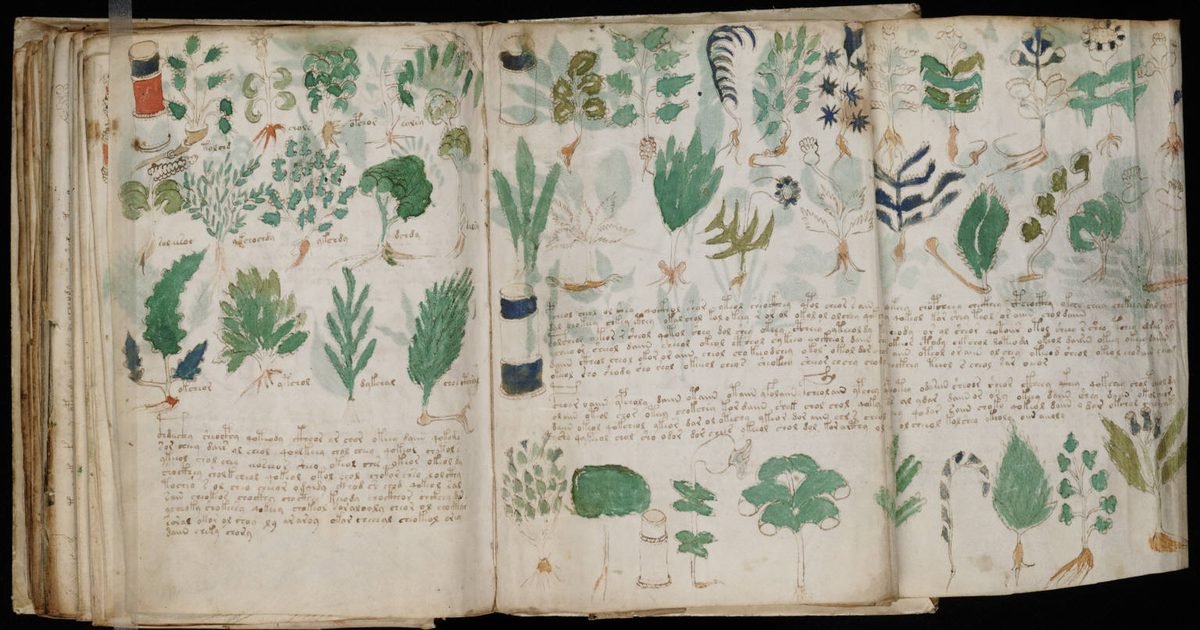
Photo: Wikimedia Commons · Public domain
Yale University's Beinecke Library in the United States holds a small book of about 240 vellum pages that is probably the most enigmatic text in the world. It's handwritten, fluently, in an alphabet unlike any other, and it's filled with drawings as strange as they are fascinating. It's called the Voynich manuscript, and in more than a century of study no one has been able to prove what it says.
A book named after a bookseller
It's named after Wilfrid Voynich, a Polish-born antiquarian bookseller who bought it in 1912 at a Jesuit villa near Rome. With the manuscript was a letter from 1665 stating that it had belonged to Holy Roman Emperor Rudolf II, a great collector of curiosities, who supposedly paid 600 gold ducats for it, a fortune at the time.
In 2009, radiocarbon dating of the vellum by the University of Arizona placed its production between 1404 and 1438. That ruled out several theories attributing the book to later authors, such as the 13th-century English philosopher Roger Bacon or 16th-century forgers, although in theory someone could have used old vellum.
What's inside
Researchers divide the manuscript into several sections based on its illustrations:
- Botanical: the largest section, with drawings of plants that mostly can't be identified with certainty. Some look like combinations of parts from different species.
- Astronomical and astrological: circular diagrams, suns, moons, stars and what appear to be zodiac signs.
- "Balneological": naked women in pools or tubs connected by pipes, one of the most baffling sections.
- Cosmological: large fold-out diagrams, including a multi-panel page some interpret as a map.
- Pharmaceutical: containers and plant parts, like the herbal recipe books of the period.
- Recipes: short paragraphs marked with stars in the margin.
The text: language, code or hoax?
The text uses between 20 and 30 distinct characters and runs to about 38,000 words. Statistical analyses show it has patterns similar to a real language: some words are very common and others rare, in proportions resembling natural languages (known as Zipf's law). But it also has oddities: words repeated two or three times in a row and very few one- or two-letter words.
There are three main hypotheses:
- A natural language written in an invented alphabet, perhaps a poorly documented language or a dialect.
- An encrypted text using some coding system of the time.
- A hoax or meaningless text made to look like a valuable book. In 2004, researcher Gordon Rugg showed that a 16th-century technique using tables and grilles could generate text with similar features, although that doesn't prove it was made that way.
Those who tried to crack it
Codebreakers who cracked ciphers in the world wars, such as American William Friedman, spent years on the manuscript without success. Every so often, someone announces they've solved it: in 2017 it was claimed to be a women's health manual in abbreviated Latin; in 2019, that it was written in a "proto-Romance" language. Specialists rejected both proposals because neither allowed the text to be translated coherently.
Artificial intelligence has had a go too. Some studies have suggested similarities with particular languages, but none has produced a verifiable translation. The honest answer, then, is that it remains undeciphered.
Recent clues
Multispectral imaging studies have revealed erased notes on some pages, which may help reconstruct who owned it. Researchers have also analyzed the inks and handwriting and proposed that several hands were involved, suggesting the work of multiple scribes rather than a lone forger. Everything points to an origin in Central Europe, probably in the 15th century.
You can see it for yourself
One of the best pieces of news is that Yale has digitized the entire manuscript and makes it freely available online in high resolution. Anyone can leaf through it on their phone. Printed facsimile editions have also been published.
Why it fascinates us
In a world where it seems you can look up anything online, a book no one can read is a reminder of the limits of our knowledge. It might be a medical treatise, a secret diary, a lost code or a 600-year-old prank. Maybe someday someone will find the key. Until then, the Voynich keeps its secret, page after page.
For information only. It does not replace advice from a health professional. Medical disclaimer
You may also like
 Animals
It looks AI-generated, but it's real: the red-lipped batfish of the Galápagos
 Health
Do you always wake up at 3 a.m.? What might be going on and how to get back to sleep
 Viral world
The Panama earthquake video watched by 23 million people: what to do if a quake catches you on a mountain, at home or on the street
 Relationships
The wedding vows that moved 8.8 million people, and what science says about couples who last
 Viral world
From Bulin 47's freestyle to AI montages: 9 clues to tell whether a viral video is real
 Animals