The mystery of the "unicorn of the sea": why the narwhal's tusk grows in a spiral yet comes out straight
It can reach three meters, twists like a corkscrew, and yet it's astonishingly straight. A recent study in Nature Communications offers an elegant explanation: spirals that cancel each other out at the molecular level.
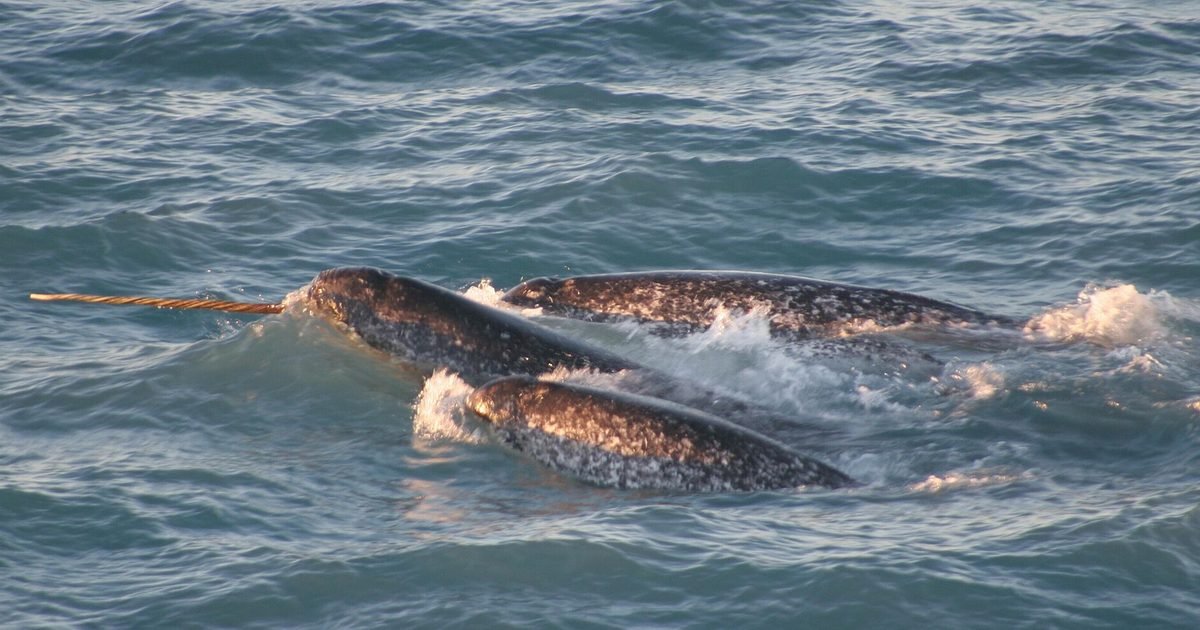
Photo: Wikimedia Commons · Public domain
For centuries, they were sold across Europe as unicorn horns. Kings and nobles paid fortunes for them, convinced they could neutralize poison. In reality, those "horns" were tusks from the narwhal (Monodon monoceros), a toothed whale that lives in the icy waters of the Arctic. And although we now know where they come from, they still hold secrets. One of them may just have been answered: how can something that grows in a spiral end up so straight?
A tooth that grows through the lip
The narwhal's famous "horn" is actually a canine tooth, usually the left one, that grows forward through the upper lip. It can reach 1.5 to 3 meters in length and weigh around 10 kilos. Mostly males have one; roughly one in seven females grows a tusk, and in rare cases individuals have two.
Unlike our teeth, the narwhal's has its hardest part on the inside and a more porous layer on the outside, crossed by millions of tiny channels connected to nerve endings. That's why many researchers think it also works as a sensory organ, able to detect changes in water salinity or temperature.
The spiral paradox
Look at a narwhal tusk and you'll see grooves winding around it, always counterclockwise (viewed from the base). Growing with a twist usually produces curved shapes, like a ram's horns or a snail's shell. Yet the narwhal's tusk stays remarkably straight over several meters. How does it manage that?
A study published in Nature Communications examined the tusk's structure with high-resolution imaging and found a clue: in different layers, collagen fibers and mineral crystals are arranged in spirals that twist in opposite directions. Those opposing twists balance each other out, so the overall result is straight growth, a bit like a well-made rope, where the yarns twist one way and the strands the other so it doesn't unravel.
Rotating while it grows may also help "average out" small asymmetries: if the tooth tended to drift to one side, the rotation spreads that drift in every direction.
What is the tusk for?
It's one of the most debated questions in marine biology. The main hypotheses are:
- Sexual selection: like a deer's antlers, a big tusk may signal good health. Males have been seen rubbing their tusks together, a behavior known as "tusking".
- Environmental sensor: the nerve-filled channels may pick up changes in the water.
- Hunting tool: in 2017, drones in Canada filmed narwhals tapping Arctic cod with their tusks to stun them before eating them.
The answer is probably a mix of all three.
An animal that's hard to study
Narwhals live in the Arctic waters of Canada, Greenland, Norway and Russia, spend months under the ice and can dive more than 1,500 meters deep to hunt halibut, squid and cod. There are thought to be about 170,000 of them. The IUCN lists them as "least concern", but they are highly sensitive to melting sea ice, increasing ship traffic and underwater noise.
Inuit communities have known them for thousands of years and still hunt them under regulation. Their traditional knowledge has been key to many scientific studies.
From legend to science
The trade in "unicorn horns" was so important in the Middle Ages and the Renaissance that the Danish coronation throne at Rosenborg Castle is said to be decorated with narwhal tusks. Today, international trade in tusks is regulated under the CITES convention.
The fascinating thing is that the more we learn about the narwhal, the more surprising it becomes. A tooth that senses, twists and grows straight thanks to spirals that cancel out: nature solved an engineering problem millions of years ago that we still struggle to copy.
Three more facts to impress your friends
- The name "narwhal" comes from Old Norse nár, "corpse", because of its pale, mottled skin.
- Narwhals have no dorsal fin, probably so they can swim more easily under the ice.
- They can live around 50 years, and some studies suggest even longer.
For information only. It does not replace advice from a health professional. Medical disclaimer
You may also like
 Animals
It looks AI-generated, but it's real: the red-lipped batfish of the Galápagos
 Health
Do you always wake up at 3 a.m.? What might be going on and how to get back to sleep
 Viral world
The Panama earthquake video watched by 23 million people: what to do if a quake catches you on a mountain, at home or on the street
 Relationships
The wedding vows that moved 8.8 million people, and what science says about couples who last
 Viral world
From Bulin 47's freestyle to AI montages: 9 clues to tell whether a viral video is real
 Animals