Tenerife striker Jesús de Miguel died after a mid-match collision: what commotio cordis is and why the first minutes are decisive
The 30-year-old suffered head and chest injuries when he collided with the Andorra goalkeeper. He died on Tuesday. Cardiologists consulted by Infobae suggest commotio cordis as a hypothesis; the official cause has not yet been released.
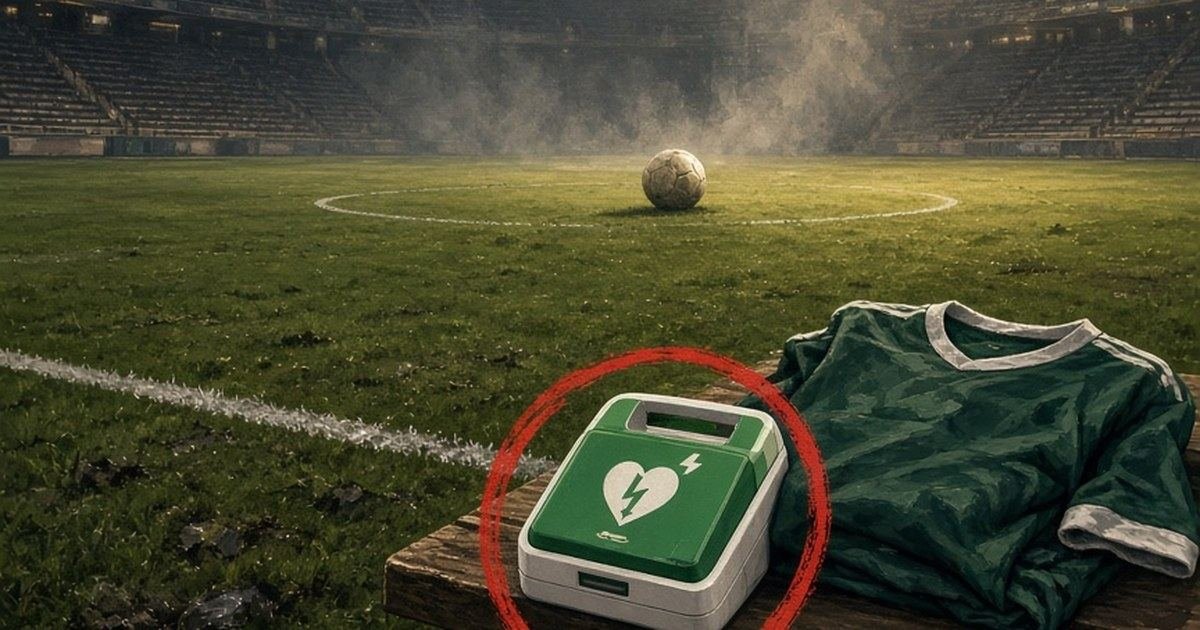
Photo: Salud3 / Imagen ilustrativa generada con IA · Imagen ilustrativa
Illustrative image: An empty, misty football stadium at night, with a defibrillator case on a bench next to a green jersey. It does not depict the match or the stadium involved.
CD Tenerife striker Jesús de Miguel, 30, died on Tuesday, November 3, a day after a heavy collision with FC Andorra goalkeeper Jesús Owono during a Spanish second-division match, his club, BBC Mundo and AP reported.
His condition had worsened overnight.
What happened on the pitch
According to BBC Mundo, Tenerife and Andorra were level at 2-2 seven minutes into stoppage time when Owono ran toward the center circle to clear a long ball and his knee appeared to strike De Miguel. The striker suffered head and chest injuries, lay motionless on the grass while medical staff treated him, and was taken by ambulance from the Heliodoro Rodríguez López stadium to hospital. Owono was sent off.
On Monday his condition was described as "stable but serious." "Broken with grief, with a lump in our throats and unable to believe this is true, CD Tenerife announces the tragic death," the club said, asking for "the utmost respect" for the family's privacy.
Spain's National Police opened an investigation, now under judicial supervision, according to EFE. AP noted that in Spain deaths from non-natural causes, including accidents, are investigated by the courts; opening an inquiry does not mean any crime has been established.
Commotio cordis: the cardiologists' hypothesis
Three cardiologists consulted by Infobae raised a possible explanation: cardiac concussion, or commotio cordis, a rare phenomenon in which a blow to the chest disrupts the heart's electrical activity. The outlet stresses that the definitive medical cause has not been officially released and will be determined by the autopsy and forensic tests; for now it is a clinical hypothesis, not a diagnosis.
"It generally occurs in completely healthy hearts, due to a combination of factors," explained cardiologist Mario Fitz Maurice of Hospital Rivadavia. According to Jorge Franchella of the UBA Hospital de Clínicas, the impact has to coincide with a window of milliseconds in the heart's electrical cycle. If it does, it can trigger ventricular fibrillation: the ventricles stop contracting in a coordinated way, blood stops reaching the brain and the person loses consciousness.
The specialists say this type of event is documented more often in softball, baseball, hockey, martial arts and basketball, and that in football a knee, an elbow or a very hard shot could also cause it, although it is exceptional.
What is in our hands
Because it depends on a coincidence of milliseconds, fully preventing commotio cordis is difficult, and routine checkups cannot always anticipate it. But all three doctors agree that the immediate response is decisive:
- Recognize the collapse: if someone falls after a blow and does not respond or breathe normally, call emergency services immediately.
- Start CPR (compressions in the center of the chest) without waiting.
- Use an automated external defibrillator (AED) as soon as possible; the device gives voice instructions.
Fitz Maurice estimated that if care begins within the first two or three minutes and a defibrillator is available, the chance of reaching hospital alive can exceed 80%. The chances drop "with every minute that is lost," Franchella warned. From the public information, it is not possible to know whether De Miguel's outcome could have been prevented.
If you or your children play contact sports, ask whether the club has an AED and trained staff, and consider taking a CPR course. If you have any questions about your heart health, talk to your doctor.
Read also: Diabetes tipo 2 en jóvenes: dieta y ejercicio supervisados lograron la remisión en la mitad · El calor se asoció a 710.000 muertes en un año: cómo protegerte
Sources
For information only. It does not replace advice from a health professional. Medical disclaimer