Peru declares an emergency in 1,380 districts over El Niño rains: dengue, the free vaccine and what you can do at home
Supreme Decree 149-2026-PCM, published on Tuesday, covers districts in 24 departments for 60 days. Peru's Health Ministry (Minsa) notes that its free dengue vaccine is for people aged 10 to 20 in priority areas, and that standing water remains the biggest risk.
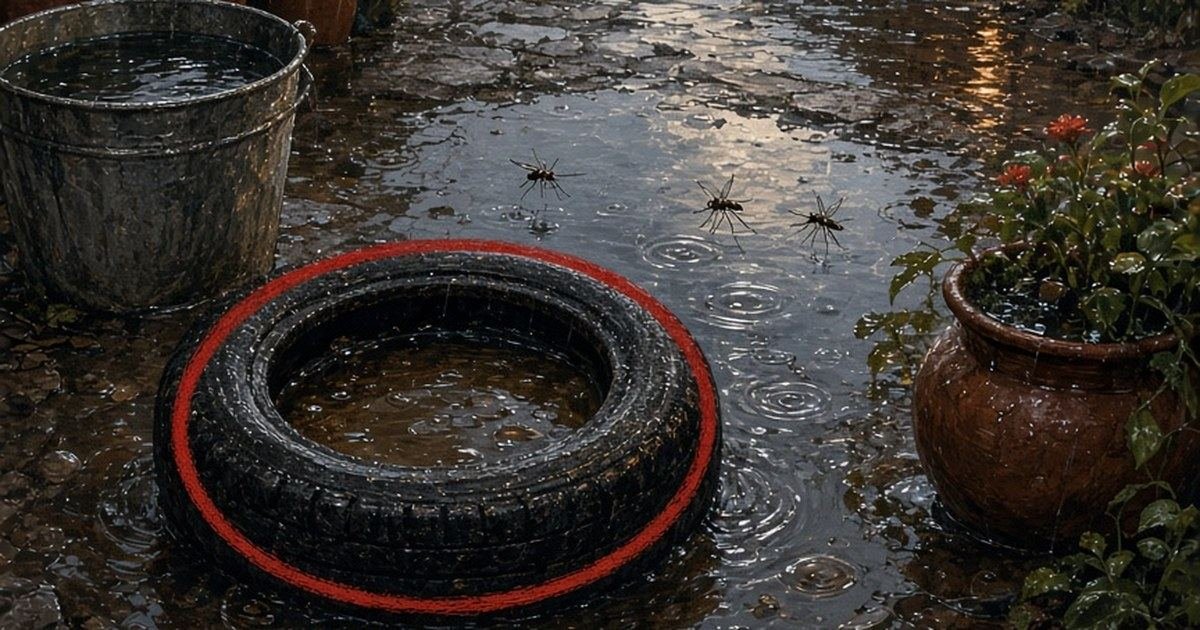
Photo: Salud3 / Imagen ilustrativa generada con IA · Imagen ilustrativa
Illustrative image: A village street in the rain with a tire and a bucket collecting water, where mosquitoes breed. It does not depict a specific place.
Peru's executive branch declared a state of emergency in 1,380 districts across 191 provinces in 24 departments due to the imminent danger of heavy rains associated with the 2026-2027 El Niño phenomenon. The measure is in force for 60 days and appears in Supreme Decree 149-2026-PCM, published on Tuesday in the official gazette El Peruano, the Andina news agency reported.
The Health Ministry is among those that signed the decree.
What the declaration says
According to Andina, the goal is to carry out "exceptional, immediate and necessary" measures to reduce the existing very high risk and to respond to and rehabilitate affected areas. Regional and local governments must carry them out with technical coordination from the National Civil Defense Institute (Indeci). The decree is signed by President Keiko Fujimori and the ministers of Health, Education, Housing, Defense, Interior and other sectors. Andina also reported that heavy rains in Tumbes have already left homes destroyed and damaged.
Dengue: the risk that grows with water
Rain and flooding make water collect in containers, where the Aedes aegypti mosquito, which transmits dengue, breeds. That is why the Health Ministry (Minsa) is continuing its free dengue vaccination campaign in priority areas, Andina noted.
- Who: children, adolescents and young people aged 10 to 20 who live in the priority areas. In Metropolitan Lima, vaccination has focused on San Juan de Lurigancho and Carabayllo.
- How many doses: two, three months apart. Completing the schedule matters.
- If you have had dengue: you must wait six months before the first dose.
- How well it protects: clinical studies of the TAK-003 (Qdenga) vaccine showed protection up to four and a half years after the second dose, with cumulative efficacy of 61.2% against symptomatic dengue and 84.1% against hospitalization, according to Andina.
The vaccine does not prevent every case. As the World Health Organization (WHO) notes, it must be combined with other measures.
What you can do at home
- Empty, cover or turn over buckets, tires, flowerpots, bottles and any container that collects rainwater.
- Clean and tightly cover the tanks and containers where you store water.
- Use repellent and, if you can, screens on windows or nets over beds.
- If you have a high fever, headache, pain behind the eyes or in the joints, do not self-medicate; go to a health facility. Signs such as severe abdominal pain, persistent vomiting or bleeding require urgent care.
To find out whether the vaccine is for you or where to get it, ask at your health center or check Minsa's official channels. If you have any symptoms, talk to your doctor.
Read also: Jesús de Miguel: qué es la commotio cordis · Alerta europea por navajas con norovirus
Sources
For information only. It does not replace advice from a health professional. Medical disclaimer